A partly built street can look alarming if you do not know the order the work runs in. Here is the sequence a new Vaughan community follows, and what each stage does and does not tell you.
Why the order of work matters to a buyer
A new community is not built house by house in the order the lots are numbered. It is built in stages, and the stages run in a largely fixed technical order because each one depends on the one before it. Underground services go in before roads. A road base goes down before framing crews need daily access. Final grading and sod wait until heavy equipment nearby is finished.
Knowing that order is useful for two practical reasons. First, it tells you what you are actually looking at when you drive through a community that is partly built, so you do not read a muddy, half-finished street as a sign that something has gone wrong. Second, it tells you which questions are answerable at the stage you are standing in, and which ones are not yet decided or not yet visible.
The Valleys of Thornhill is in the City of Vaughan, in York Region, just off Major Mackenzie Drive West between Dufferin Street and Bathurst Street. Three builders are delivering homes here: Treasure Hill with two-car garage townhomes, Starlane Home Corp. with two-car garage 33-foot singles, and Greenpark Group with two and three-car garage 38-foot and 50-foot singles. The builders page sets out who delivers what, and the development overview covers how the community is laid out.
Stage one: earthworks and servicing
The first visible work on a new block has nothing to do with houses. Topsoil is stripped and stockpiled, often in large mounds that sit for a long time before being spread back. The land is then rough graded to the elevations set in the approved engineering drawings, which is the point at which the drainage pattern for every lot on the street is effectively locked in. Our guide to lot grading, drainage and easements explains how that pattern is designed, inspected and enforced.
After grading comes servicing. Deep trenches carry sanitary and storm sewers and the watermain down the centre of the future road, with a service lateral stubbed toward each lot. Hydro, gas and telecommunications ducts follow, usually shallower and often along the boulevard. Stormwater management facilities and any required ponds are built as part of this stage, not added at the end.
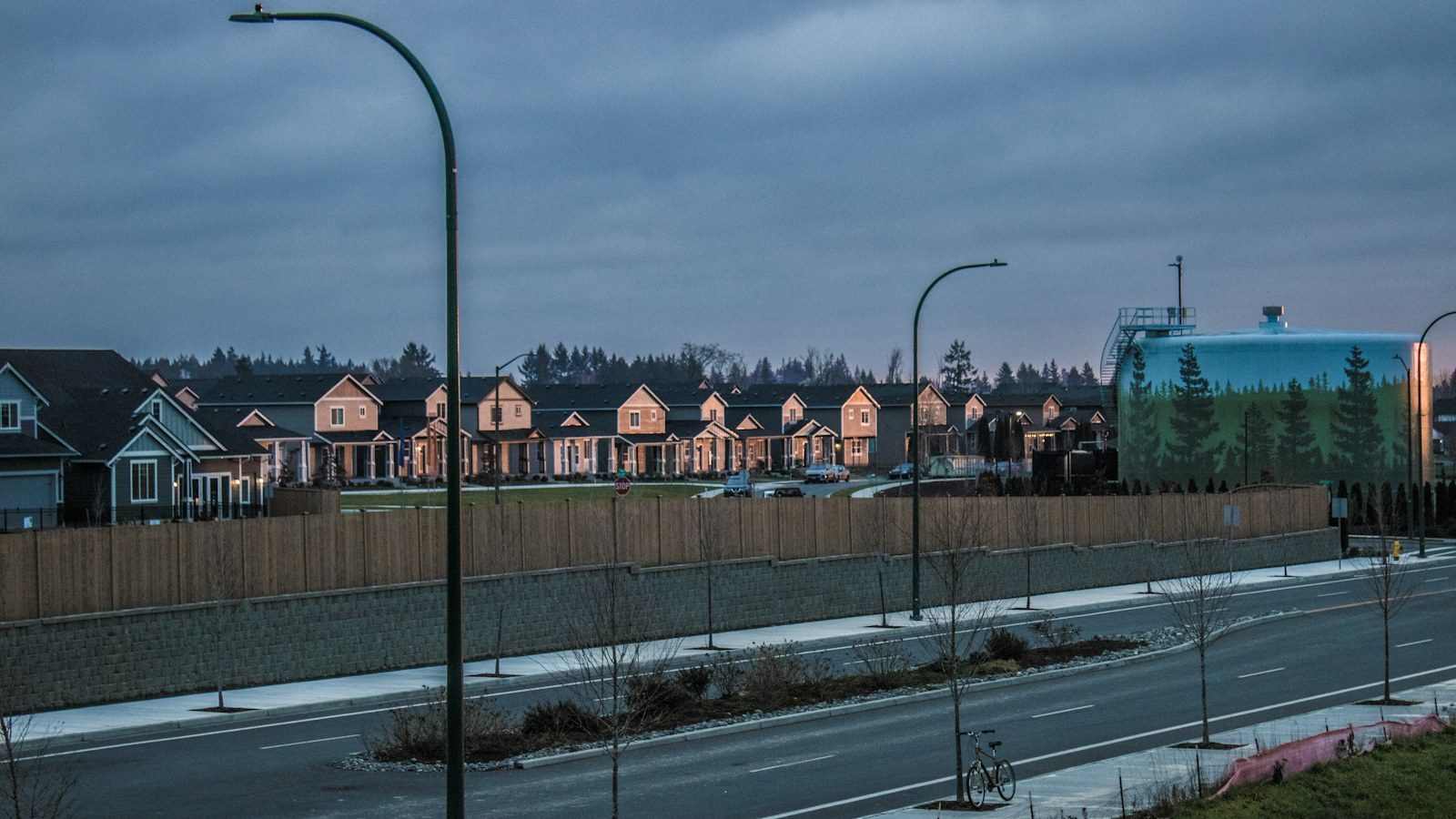
Then the road is formed: curbs poured, granular base laid, and a first course of asphalt put down so trucks can get in and out. At this point the street has a shape and a surface but almost nothing else. No sidewalk, no street lights, no boulevard trees.
What this stage tells you: whether the lot you are considering sits high or low in the grading pattern, where the construction entrance is, and where the pond or utility blocks are relative to your lot. What it does not tell you: anything about the finished look of the street.
Stage two: foundations, framing, and the long quiet middle
Footings and foundation walls go in, the foundation is backfilled, and framing starts. From the street this is the stage that feels fastest, because the change week to week is dramatic: a floor, then walls, then a roof, then brick or stone and windows.
What follows is slower and almost invisible from outside. Mechanical, electrical and plumbing rough-ins, insulation, drywall, trim, flooring, cabinetry and finishes all happen behind a closed exterior. A home can look essentially complete from the sidewalk while a great deal of interior work remains.
This matters when you are gauging progress on a visit. An exterior that reads as finished is not a reliable signal of how close a home is to being ready for occupancy. The sequencing and the documents that govern it are covered in the broader pre-construction timeline, and the inspection that happens before you take keys is set out in our pre-delivery inspection guide.
Stage three: the street gets finished last
Roads in a new subdivision are typically paved in two passes. The base course goes down early, as described above, and the top course goes on much later, once the bulk of heavy construction traffic on that street is done. That final lift is sometimes placed after residents have already moved in, which is why a newly occupied street can have a slightly sunken look where it meets the curb, and manhole covers sitting low.
Several other street elements arrive late in the process, in no fixed order:
- Sidewalks and boulevard restoration
- Street lights, which may be installed before they are energized
- Boulevard trees, planted in the municipal right of way rather than on your lot
- Permanent street signs, replacing temporary construction signage
- Community mailboxes, placed at locations determined by Canada Post
Until the municipality formally assumes the subdivision, the builder generally remains responsible for maintaining these works. Ask who is responsible for snow clearing, street sweeping and sidewalk repair on your street at the point you would be moving in, and get the answer in writing. Your first year living in a brand new community covers what day-to-day life looks like while this is still in progress.
Stage four: your own lot
The work on your lot finishes in roughly this order: final grading to the approved plan, driveway, sod or seed, and any trees, fencing or walkways the builder is responsible for. Driveways are often paved in two passes for the same reason roads are. Sod is placed in the growing season, so a home that closes in winter may sit on bare, graded soil for a period.
What the builder provides varies, and the distinction between what is included and what is yours to install later is worth reading closely before you sign. Sod, trees, fences and driveways walks through that, and reading a builder's features and finishes list explains how to interpret the language used.
The final grading certificate, prepared by a surveyor or engineer and submitted to the City, is the document confirming your lot was built to the approved grades. Ask when it is issued and how you can obtain a copy.
What to look at on a repeat visit
If you visit a community more than once, the construction stage is one of the most informative things to track. On each visit, note:
- How far the active construction front is from the lot you are considering, and which direction it is moving
- Where trucks enter and exit, and which streets they use to get there
- Whether sidewalks on your side of the street are in, since that determines whether you can walk anywhere yet
- Where material stockpiles, portable toilets and site trailers are placed
- How water sits on the ground after rain or a thaw
Walkability is a good example of something that changes with the stage rather than the plan. Carrville Community Centre is 0.3 km from the community and Carrville Library is 0.4 km, both walkable, and Pioneer Park is 0.7 km and walkable. Whether you can actually walk those routes comfortably on the day you move in depends on which sidewalks and crossings are complete. Planning repeat visits sets out a structure for comparing visits rather than relying on a single impression.
Who to ask about what
Responsibility is split, and asking the wrong party produces a vague answer.
- The builder for anything about your home and your lot: grading, driveway, sod, finishes, and the schedule as it affects your purchase. Ask for answers in writing.
- The City of Vaughan for local roads, sidewalks, boulevard trees, waste collection and subdivision assumption.
- York Region for arterial roads such as Major Mackenzie Drive West, and for water and wastewater infrastructure.
The division is explained in who looks after what in Maple. For anything on adjacent land that is not yet built, the City's development application records are the place to check, as described in checking a Vaughan lot against the public records.
This is an independent information site about The Valleys of Thornhill. We do not represent any of the builders, and construction staging, responsibilities and schedules should always be confirmed directly with the builder in writing and with the City of Vaughan. If there is something you saw on site that you want help interpreting, get in touch.
Have Questions About Pre-Construction?
Matthew Caporiccio can help you understand pricing, deposit structures, and availability at The Valleys of Thornhill and other pre-construction projects across the GTA.