Most buyers see a community once, on a dry weekend afternoon, arranged around sales office hours. Here is how to structure four separate visits so each one tells you something the others cannot, and how to keep a record you can still read when you are comparing three communities.
Why one visit is not enough
Most buyers make a single trip to a community they are considering. It is usually a weekend, usually in daylight, usually dry, and usually scheduled around when a sales office is open. That trip is worth making, but it samples about one hour out of a week you would be living in for years.
A neighbourhood is not a constant. The same street carries different traffic at 8:00 a.m. than at 2:00 p.m. It is lit differently in December than in June. It behaves differently the morning after a storm than on a clear afternoon. If you are weighing two or three communities against each other, repeat visits are the cheapest research available to you. They cost fuel and a few hours.
The Valleys of Thornhill is in the City of Vaughan, in York Region, just off Major Mackenzie Drive West between Dufferin Street and Bathurst Street. The postal city is Maple and the local area is known as Patterson and Carrville, which catches some buyers off guard — that naming question is handled separately in why the community is in Maple, not Thornhill. What follows is a way to split your visits so each one answers a different question.
Visit one: a weekday morning
Go between 7:30 and 8:45 a.m. on a school day. This is the hour that decides whether the location works for a household, and it is the hour you will almost never see on a sales appointment.
What to pay attention to:
- The turn onto the arterial. Sit at the intersection you would use every day and count how long it takes to get out. A left turn without a signal at 8:15 a.m. is a different experience than the same turn at noon.
- The school run. Anne Frank Public School is 0.8 km away, roughly a 1 minute drive, and Alexander MacKenzie High School is 2.9 km, about 5 minutes. Drive those routes at the actual hour. Note where cars queue, where the crossing guards are, and whether you would walk it instead.
- The commute leg. Maple GO Station is 3.3 km and about 6 minutes; Rutherford GO Station is 4.6 km and about 7 minutes; Vaughan Metropolitan Centre Station is 14.1 km and about 16 minutes. Published drive times assume normal conditions. If you intend to park at a GO station, go into the lot on a weekday morning and see how full it is and how early. Commuting from here covers the routes in more detail.
Visit two: a weekday evening
Come back on a weeknight, after 6:30 p.m., and ideally after dark for part of the year. Evening tells you how a street is actually used rather than how it was drawn.
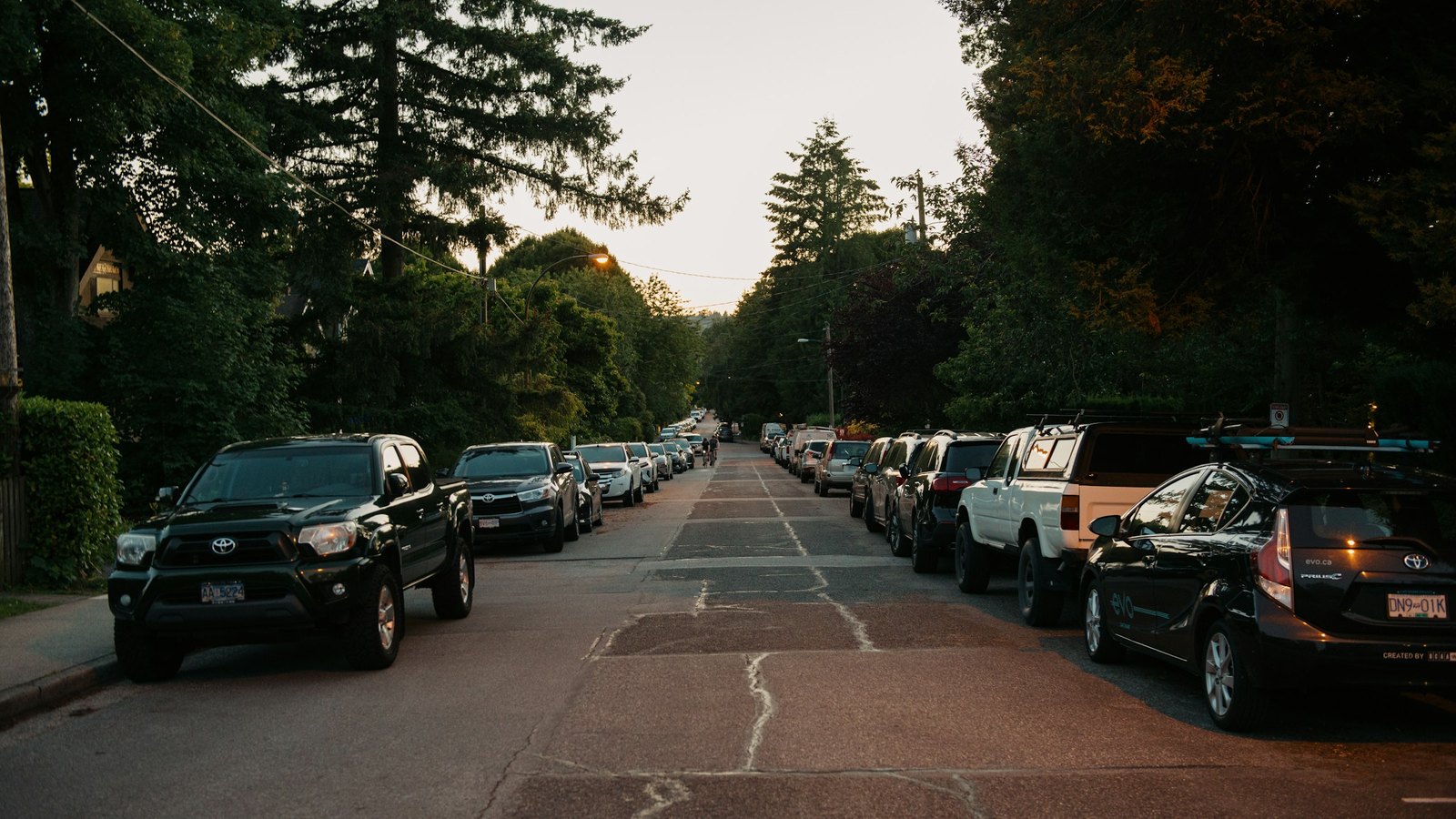
- On-street parking. Count the cars parked on the road on an occupied street. That number tells you how many households have more vehicles than driveway spaces, and it is the single best predictor of what the street will feel like once your own block fills in.
- Lighting. Walk a block and notice where the street lights are, where the gaps are, and whether the walkway you would use is lit end to end.
- Noise. Stand still for five minutes with the car off. You will hear the arterial, the nearby rail corridor if there is one, or nothing much. All three are useful findings.
Parking capacity is not uniform across this community, because the three builders are delivering different products. Treasure Hill is building two-car garage townhomes. Starlane Home Corp. is building two-car garage 33-foot singles. Greenpark Group is building two- and three-car garage 38-foot and 50-foot singles. Those differences change how many vehicles a household can keep off the street, which is set out in garages and parking across the homes here and in the builder overview.
Visit three: a weekend afternoon, on foot
Park once and leave the car. The short distances are the ones people over-promise themselves, and walking is the only honest test.
Carrville Community Centre is 0.3 km from the community and Carrville Library is 0.4 km — both walkable. Pioneer Park is 0.7 km, also walkable, and Heritage Park is 0.9 km, about a 1 minute drive. Walk to at least two of them and check whether there is a continuous sidewalk, how you cross any larger road on the way, and whether you would send a child on that route alone. A walk that works becomes a daily habit. A walk with one bad crossing becomes a drive, and that quietly changes how you use the whole neighbourhood. The full set of nearby schools and green space is listed in schools and parks near the community.
While you are out, do a real errand rather than a drive-by. Longo's and the Walmart Supercentre are each 2.8 km and about 5 minutes. Hillcrest Mall is 4.6 km and about 8 minutes, Promenade Mall is 7.3 km and about 11 minutes, and Vaughan Mills is 8.2 km and about 12 minutes. Mackenzie Health — Richmond Hill Hospital is 3.0 km and about 5 minutes; Cortellucci Vaughan Hospital is 6.4 km and about 10 minutes. Buy something, park, and come back. Those details are collected in daily errands in Carrville. If you have children, Canada's Wonderland at 7.0 km and about 13 minutes and North Maple Regional Park at 5.0 km and roughly a 15 minute drive are both worth seeing at least once.
Visit four: deliberately bad conditions
Pick the worst day you are willing to drive in and go. Rain, slush, or the day after a snowfall. Bad weather is when a street stops performing and starts revealing: where water pools, where snow gets stored, how wide the road really is once both edges are banked, and how quickly sidewalks are cleared.
That visit deserves its own checklist, and there is one in what to look for on a winter drive through a Vaughan neighbourhood. If you can only manage one cold-weather trip, make it within a day or two of a snowfall rather than on a clear cold day — clearing performance is the thing you are measuring.
Write it down, because it blurs
By the time you have seen three communities across four visits each, your memory will merge them. Keep a single page per community with the same headings every time: morning exit, parking, lighting, walk test, errand test, bad weather. Same questions, same order, so the comparison is like for like.
Two things make that record more useful. First, take photographs with timestamps, especially of parking and of anything you want to raise later. Second, note the date and the weather at the top of each entry, because a note that says "street felt tight" means something different on a February morning than on a dry Sunday.
A structured way to turn those notes into a decision is in how to compare new home communities in Vaughan.
What visits cannot tell you, and how to check it yourself
Some of the most important facts are not visible from a car, and you should not take them from a brochure either. Get them from the source:
- School assignment. Boundaries are set by the York Region District School Board and the York Catholic District School Board, and they are reviewed as new communities fill in. Use each board's address lookup rather than assuming the nearest school is the assigned one.
- Road and sidewalk maintenance. Local streets and regional arterials are typically maintained by different authorities in York Region. Confirm with the City of Vaughan and with York Region which body is responsible for your street and for Major Mackenzie Drive West, and which sidewalks the City clears.
- Parking bylaws. On-street and overnight parking rules are municipal and they change. Check the City of Vaughan's parking pages instead of inferring the rules from what you saw parked.
- Future construction nearby. The vacant block beside a community is not permanently vacant. The City of Vaughan publishes development applications; search the surrounding streets before you choose a lot that backs onto open land.
- Your specific lot. Grading, easements, and what sits behind and beside you are on paper before they are on the ground. Ask the builder for the site plan and lot grading plan, and read them — how to read a builder's site plan explains what to look for.
Be fair to a community that is still being built, too. Construction traffic, mud, bare front yards and young trees make any new street look harsher than it will look in five years. That is a stage, not a verdict, and your first year in a brand new community describes what that period is genuinely like.
This site is independent. We are not a builder and we do not speak for one, so anything tied to a particular lot, plan or release should be confirmed with the builder directly. You can read more about the community on the development page, and if a question is better answered by a person, get in touch.
Have Questions About Pre-Construction?
Matthew Caporiccio can help you understand pricing, deposit structures, and availability at The Valleys of Thornhill and other pre-construction projects across the GTA.